At the AIS Summit in Hamburg this year, Co-founder and CEO, Owen Taylor presented a simple question that hides a difficult challenge. How do you grow from a standing start to a global network of one hundred thousand active AIS receivers? Every maritime company wants better coverage, richer data, and more reliable visibility of vessel movements. Yet the infrastructure needed to capture that information is limited, uneven, and difficult to scale under the current volunteer-driven model.
AIS datasets power port logistics, supply chain intelligence, emissions monitoring, insurance models, and financial analytics. They are valuable, but the systems that gather terrestrial AIS signals have barely moved beyond a narrow group of hobbyists who set up receivers at home. The largest of those networks top out at around six thousand active stations worldwide. It is an impressive achievement for volunteers, but it is far below what is needed for true global visibility.
The question we raised in Hamburg is the same one that technology networks have faced for years. How do you break the cold start problem?
Understanding the cold start challenge
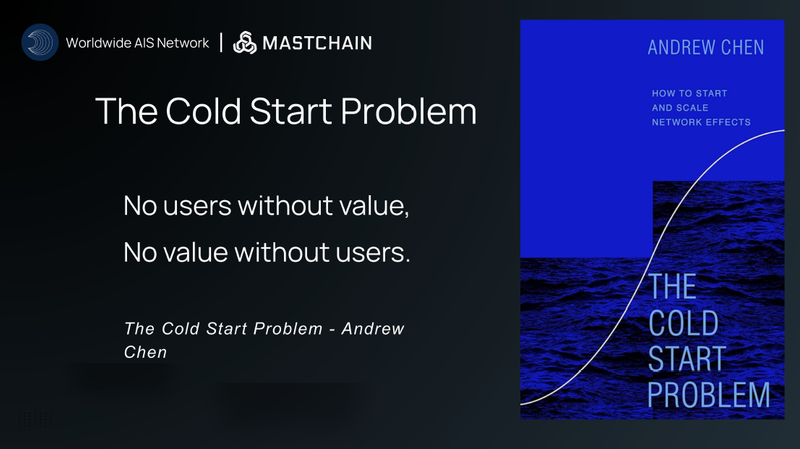
The cold start problem describes a circular trap. A network needs enough participants to generate value, but people won’t join until there is value already present. Andrew Chen’s work on network effects summarises this loop neatly. No users without value and no value without users. This is why so many networks stall early, never reaching the momentum needed to grow naturally.
Terrestrial AIS is stuck in this trap. Coverage is strongest in areas where hobbyists are already active, usually Europe and North America. As a result, the data remains skewed toward regions with strong volunteer culture rather than toward regions with high maritime traffic. This is the exact opposite of what commercial and institutional users need. At the same time, the demographic of contributors is narrow. Participants tend to be technically inclined, mostly male, and motivated by personal interest rather than direct benefit. They contribute because they enjoy the hobby, not because they are rewarded for the work.
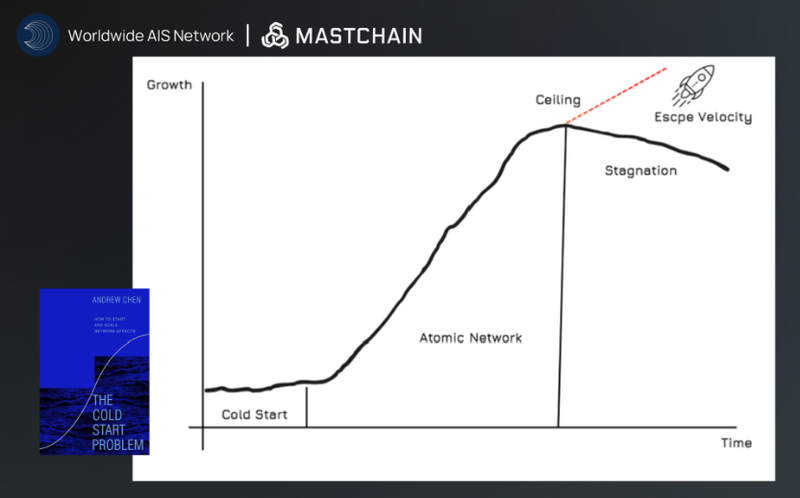
This narrow base creates a ceiling. Growth slows even if demand increases. The network has value, but not enough to attract significant new participation, and this is where stagnation sets in.
Breaking through this ceiling requires a different approach to participation, ownership, and incentives.
Why Web3 changes the picture
Web3 offers something the current model cannot. It allows anyone, anywhere in the world, to take part in infrastructure projects without needing to trust a central authority or rely on goodwill. Participation becomes open. Data can be verified and stored in ways that are tamper-resistant. Most importantly, contributors can be rewarded directly for operating hardware and providing useful coverage.
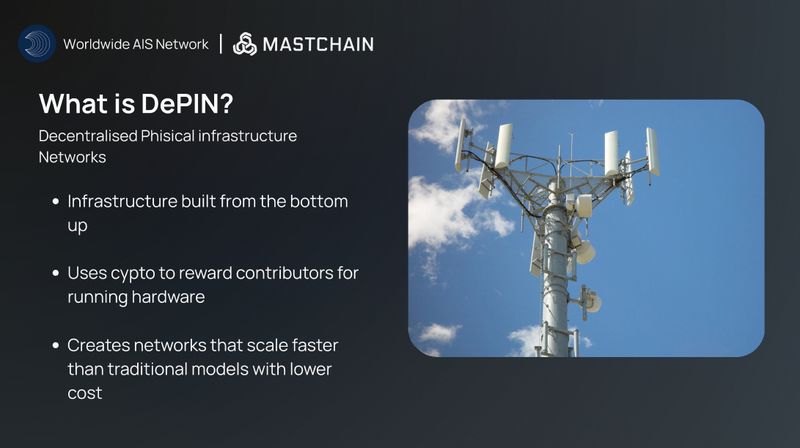
This is the principle behind decentralised physical infrastructure networks, often referred to as DePIN. These networks have already reshaped other sectors. They build infrastructure from the bottom up, using crypto incentives to reward those who deploy and maintain hardware. This produces a distribution of nodes that grows far faster than traditional, centralised deployment models.
The results speak for themselves. Wingbits went from zero to seven thousand flight-tracking nodes in just two years, scaling six times faster than any network before it. Helium reached more than a million telecom nodes in three years. Silencio grew to over a million noise-mapping devices in two years. These projects grew because contributors were rewarded, the data was verifiable, and the cost of expansion was shared across a global base of participants.
The question is whether this model can be applied to AIS. At Mastchain, we believe it can.
Introducing Mastchain: the first DePIN for AIS data
Mastchain is designed to break through the limits of the current terrestrial AIS landscape. We aim to expand from today’s atomic network of around six thousand receivers to a global system supported by a potential pool of more than one hundred eighty thousand crypto-native coastal operators.
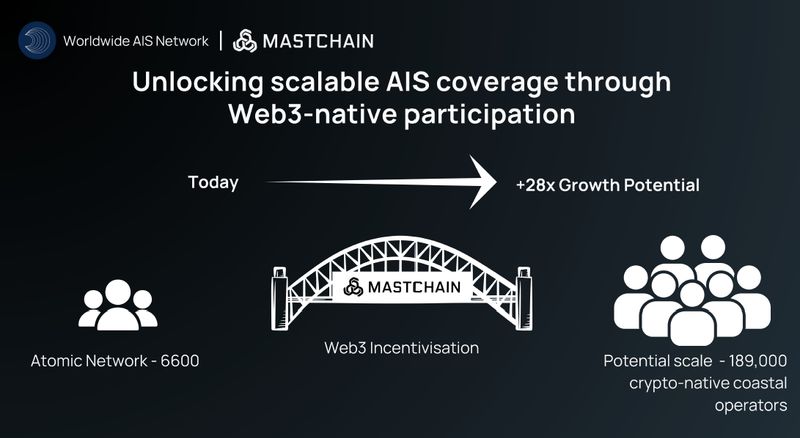
The idea is simple. Instead of relying on the same volunteer demographic, we open the network to anyone with access to the coastline and basic hardware. A Web3-native rewards system compensates contributors for the data they capture. Participation becomes accessible across Latin America, Africa, Southeast Asia, and island nations where AIS coverage is currently sparse but maritime activity is high.
Our goals are clear.
First, to expand beyond the existing ceiling by introducing new groups of operators. Second, to reward those operators fairly for their data. Third, to use blockchain verification to ensure the authenticity and integrity of every message collected.
This creates a feedback loop that builds value. More contributors deliver richer coverage. Richer coverage increases the value of the dataset. As value increases, so do rewards for contributors. This drives even wider participation, which increases the network’s density and resilience.
The cold start problem becomes solvable.
Why the AIS sector is ready for this shift
AIS has reached an inflection point. Maritime firms want higher quality terrestrial data. Regulators, insurers, and supply chain analysts want broader and more reliable visibility. Port operators want better local readings. At the same time, individuals in developing regions are looking for income streams that use low-cost hardware and affordable connectivity.
These two forces align in a way that traditional AIS networks cannot fully capture but a DePIN model can.
Most AIS receivers are simple, inexpensive, and easy to maintain. This makes them ideal for distributed installation. The bandwidth required is low. The operational cost is trivial. What has been missing is a mechanism that ties individual effort to measurable reward and ensures that data collectors are compensated when the data is monetised.
Using Web3 incentives provides that missing link. It gives contributors a clear reason to join, and it brings new geographic regions into play immediately. Instead of waiting for volunteer growth, the network expands because people have a direct reason to participate.
Scaling beyond the limits of legacy networks
Traditional AIS networks face structural barriers that slow their scalability. Even when their communities are strong, they eventually reach saturation in their core regions. Adding receivers in areas with low population density or low hobbyist interest becomes difficult, and those are often the areas where maritime activity is busiest.
This is why growth hits a ceiling. After the initial rise of the atomic network, the curve begins to flatten. Without new incentives or new participants, the system stagnates.
By contrast, Mastchain uses Web3 incentives as a bridge. The potential contributor pool expands by twenty-eight times. A coastal village in the Philippines can operate a receiver. A fisherman in Ghana can operate one. A student in Chile can operate one. These regions are not just underserved; they are valuable. Many of the world’s busiest shipping corridors pass directly in front of communities that have never been asked to participate in AIS data capture.
When participation is global, the network grows in a way that was not previously possible. The ceiling disappears, replaced by a trajectory where increased density leads to better signal quality, better data resolution, and a stronger dataset for commercial buyers.
The power of verifiable data
One of Mastchain’s most important contributions is the verification layer. AIS data is only useful if its source is known and reliable. Blockchain allows every message to carry a proof of origin. A contributor cannot fake a geographic footprint or spoof messages without detection. This ensures that what is being sold downstream is accurate, timestamped, and traceable to a verified source.
This strengthens trust in the dataset and reinforces the reward mechanism. High-quality data leads to high-quality rewards. Contributors are encouraged to maintain uptime, update equipment, and operate responsibly. Poor-quality data is screened out automatically.
In other words, the same trustless properties that make Web3 attractive for finance also help protect the integrity of a global AIS network.
A new path forward for AIS
The AIS sector has reached the point where better data is essential. The industry has relied on volunteers for more than a decade, and their contributions have been significant. But the maritime world is more complex, more connected, and more data-driven than ever before. The next stage of AIS growth requires a new foundation.
Mastchain offers that foundation. A decentralised, verifiable, incentive-driven way to scale AIS coverage globally. A model that aligns the interests of data consumers with the interests of contributors. A system that brings in new operators from regions where AIS coverage is most needed. And a network that grows with the speed and resilience that only distributed participation can deliver.
The cold start problem does not have a single quick fix. It is solved by combining technology, economics, and community in a way that encourages people to take part. This is what Web3 does best. It turns participation into ownership and turns infrastructure into a shared global network.
Mastchain is building the first DePIN for AIS data, and we believe it will reshape how maritime data is gathered, secured, and shared. Coverage will grow faster. Data will be more trusted. Contributors will be fairly rewarded. And the global maritime sector will benefit from visibility that is broader, deeper, and more accurate than anything that exists today.
The cold start problem was the challenge. Web3 participation is the solution.
About Mastchain
Mastchain is building the first decentralised infrastructure network dedicated to AIS data. Our platform enables people around the world to operate low cost coastal AIS receivers and earn rewards for the data they capture. Every message is verified on chain, creating a trusted, tamper resistant dataset that grows in value as the network expands. By combining Web3 incentives with maritime technology, Mastchain unlocks global participation in AIS coverage and delivers a new standard of accuracy, transparency, and scale for the organisations that depend on maritime data.